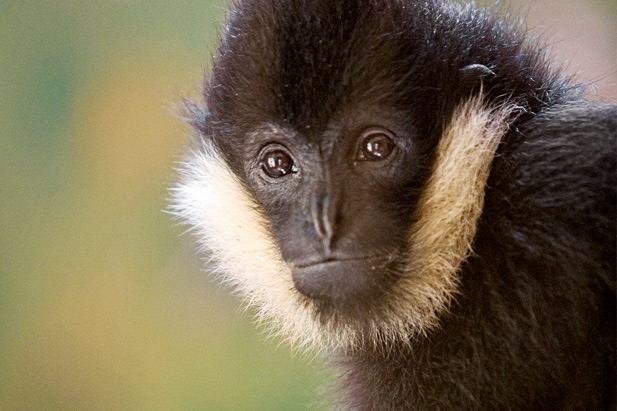
White-cheeked gibbon
Monkeys and lemurs
Asian animals
Gibbon monkeys spend most of their lives in the canopy and they are great climbers. They have long strong arms that are well adapted to an acrobatic life and they have very good balance. Gibbons are one of the anthropoid apes and it is fascinating to see the similarities with humans. Female and male white-cheeked gibbons are very similar in size but differ in colour. Females have light yellowish-brown fur and a black patch on their forehead, while males are black with white cheeks. Newborn chicks have a yellowish colour to their fur and after about six months the fur turns black in both females and males. When females reach sexual maturity, the colour changes again and they become lighter while the males' fur remains black. The zoo participates in the European breeding programme, EEP, for the conservation of the white-cheeked gibbon.
CITES A
The facts
| Scientific name | Nomascus leucogenys |
| Size | 50-60 cm |
| Weight | 5-7 kg |
| Food | Fruits, leaves, buds and insects |
| Gestation period | 7-8 months |
| Number of cubs | 1 pc |
| Lifespan | 25-30 years |
| Living environment | Tropical forest |
| Distribution | South East Asia |
| Way of life | Group living |
Taxonomy
| Class | Mammals (Mammalia) |
| Organisation | Primates (Primates) |
| Family | Gibbons (Hylobatidae) |
| Type | White-cheeked gibbon (Nomascus leucogenys) |


