Struts – Newcomer
African animals
Birds
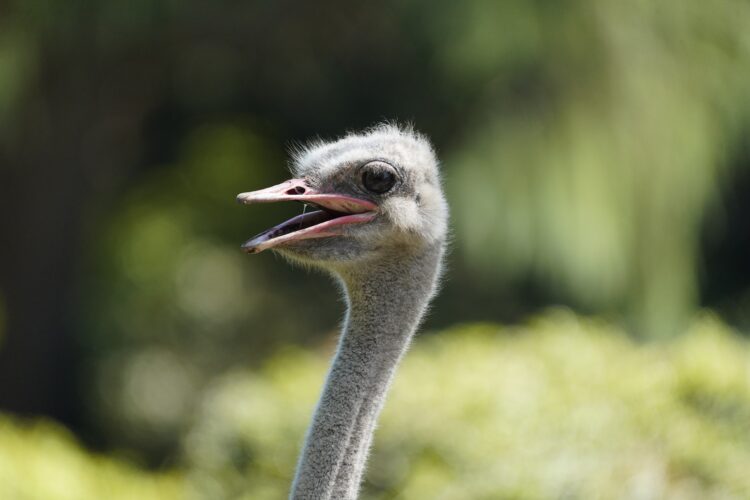
The ostrich is the world's largest living bird – an impressive sight on the savannah! With its height, strong legs, and watchful gaze, it is perfectly adapted for a life on open plains. A fascinating fact is that the ostrich's brain is smaller than its eyes. A large part of the skull's space is thus occupied by the eye sockets. Its outstanding eyesight allows it to detect predators at long distances, and its long, dense eyelashes protect against both sandstorms and thorny bushes. Like most birds, the ostrich also has well-developed colour vision. Despite myths to the contrary, the ostrich is far from stupid; it has developed smart and effective strategies for surviving in a harsh environment.
A persistent myth claims that the ostrich buries its head in the sand when frightened, which is not true. Instead, it relies on its good eyesight and incredible speed. It can run at over 70 km/h, making it the world's fastest bipedal animal. Each foot has two toes, and the longer one is equipped with a strong claw. The claws are used both for digging and as a defensive weapon. If an ostrich cannot outrun danger, it can use its strong, muscular legs to deliver powerful kicks, strong enough to kill a large predator.
Today, ostriches are found as domestic animals in many countries, where they are farmed for their meat and skins. Their feathers are also utilised and used for decorations, fashion, and feather dusters, amongst other things. At the same time, the number of wild ostriches is decreasing, and has been for a long time. The main reason for this is that their natural habitats are disappearing as land is converted to agriculture by humans.
The facts
| Scientific name | Ostrich |
| Size | 175-275 cm |
| Weight | 90-150 kg |
| Food | Grass, seeds, insects and small mammals |
| Gestation period | 42-46 days |
| Number of cubs | approx. 20 pc |
| Lifespan | around 40 years old |
| Living environment | Savanna |
| Distribution | Africa |
| Way of life | Flock |
Taxonomy
| Class | Birds (Aves) |
| Organisation | Ratites |
| Family | Ostrich (Struthionidae) |
| Type | Ostriches (Struthio camelus) |
