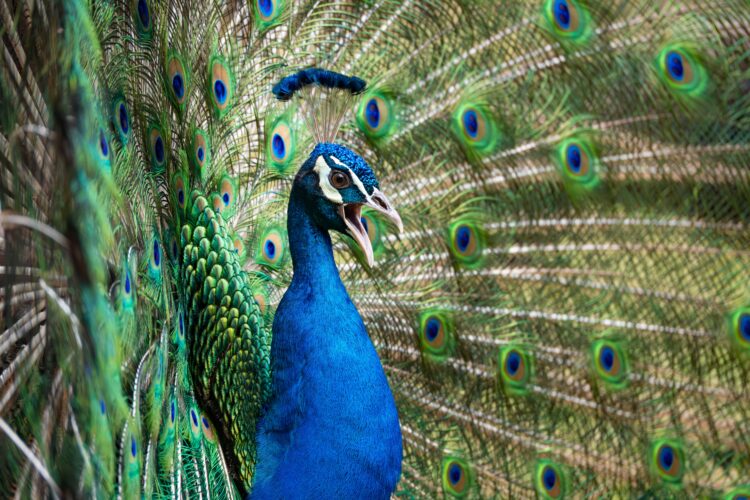
Peacock – New arrival
Asian animals
Birds
The peacock is one of the largest species of fowl, with a powerful and stately build. Despite its impressive size and magnificent tail, it is a skilled flyer. As evening falls, it seeks shelter in the treetops to spend the night.
It is primarily the male who attracts attention with his approximately 150 tail feathers. The male's tail is not fully developed until he is three years old, and each year he loses all his tail feathers, only for new ones to grow back over the winter, ready to be displayed during the next mating season. The female is considerably more discreet in her colouring and lacks the long, brightly coloured tail. Peafowl live in small groups, usually with one male and three to five females. When it is time to nest, the female builds her nest on the ground, well hidden among leaves and dense vegetation, where the eggs and chicks are protected.
During the mating season, the male lifts and spreads his tail feathers like a huge fan and vibrates them to impress the females. The male can also emit a powerful, loud, yelping cry that can be heard over long distances. The call serves as an effective warning signal in times of danger; for both its own group and other nearby animals. Wild peacocks live in forest areas in India, Pakistan, and Sri Lanka. They have also been introduced to parks and botanical gardens around the world, where they are appreciated for their beauty and characteristic behaviour.
The facts
| Scientific name | Peafowl |
| Size | 95-125 cm |
| Weight | 2-6 kg |
| Food | Seeds, berries, insects |
| Gestation period | 4 weeks |
| Number of cubs | 4-6 st |
| Lifespan | 15-20 years |
| Living environment | Woodland and scrub |
| Distribution | Asia |
| Way of life | Group living |
Taxonomy
| Class | Birds (Aves) |
| Organisation | Galliforms |
| Family | Pheasant family (Phasianidae) |
| Type | Peacock (Pavo cristatus) |
