The Komodo dragon
Asian animals
Reptiles
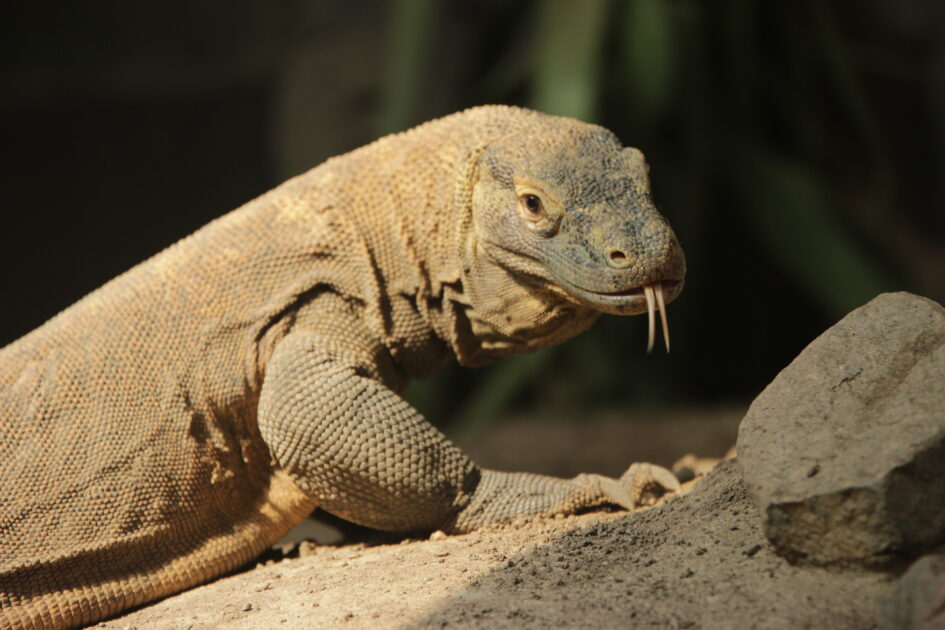
The Komodo dragon is the largest lizard in the world and today there are only about 3,000 individuals left. They live in an area of less than 1,000 square kilometres in the Indonesian archipelago and since 1980 the area has been classified as a national park. Komodo dragons hunt both small and large prey and they also eat carrion that they find. They have a 50 cm long forked tongue which, like other reptiles, acts as an olfactory organ. When the wind is right, a Komodo dragon can smell a rotting carcass from miles away! Komodo dragons have a stout body, often with a pendulous abdomen. Their legs are muscular and their long toes have sharp, hooked claws. Its tail is slightly shorter than its body and when walking, the Komodo dragon often rests the tip of its tail on the ground, drawing a pattern between its footprints. When defending itself, it bites with its sharp teeth and powerful jaws and whips with its muscular tail. When hunting, they often lurk on the prey and make an attack that is often directly fatal, but if the bite is not directly fatal, the Komodo dragon continues to guard the prey. In its mouth, the Komodo dragon carries over 50 different bacteria and a venom that acts as an anticoagulant that can kill a prey animal by causing the wound to continue bleeding and the animal to either bleed to death or die from infection.
Visiting heads of state have sometimes received Komodo dragons as gifts, and this is how the species spread to zoos outside Indonesia back in the 1960s. Today, the Indonesian government has strict control over the species and authorisation from the President is required to take an individual out of the country.
The zoo participates in the European Breeding Programme (EEP) for the conservation of the species.
CITES A
In situ - Conservation in place
Conserving endangered species, and preventing them from becoming extinct, requires efforts at several points in the chain. In the zoo, we can contribute with breeding and research to create a gene bank, while learning more about the species' behaviours and needs. Conservation work in zoos is called ex-situ, which means that the work is carried out outside the species' home range. Conservation measures are also taken in-situ, i.e. in the area where the species lives or has lived in the past. We at Parken Zoo contribute to several such projects, for example Komodo Survival Programme.
The project works to protect and conserve Komodo dragons, which are endemic to a few islands in Indonesia. The project is based on four pillars:
- Scientific research and monitoring programmes on the biology and ecology of the Komodo dragon and the terrestrial biodiversity of its home range.
- Training and capacity building for Indonesian citizens so that they can carry out conservation work themselves.
- Provision and dissemination of reliable and easily accessible information on Komodo dragons.
- Promoting sustainable development and conservation of
awareness initiatives for local communities in and around the natural habitat of Komodo dragons.
If you also want to contribute, or read more, visit komododragon.org
The facts
| Scientific name | Varanus komodoensis |
| Size | up to 300 cm |
| Weight | usually: males 40-80kg and females 25-35kg |
| Food | Small mammals, birds, deer, wild boar |
| Gestation period | Eggs are laid about 50 days after mating and hatch after 8-9 months |
| Number of cubs | about 20 per litter |
| Lifespan | Over 20 years |
| Living environment | Dry monsoon forest, tropical savannah, steppe |
| Distribution | Komodo, Rinca, Padar and western Flores islands in the Indonesian archipelago |
| Way of life | People living alone |
Taxonomy
| Class | Reptiles (Reptilia) |
| Organisation | Moulting reptiles (Squamata) |
| Family | Varanasi (Varanidae) |
| Type | Komodo dragon (Varanus komodoensis) |