Guereza – New Resident
African animals
Monkeys and lemurs
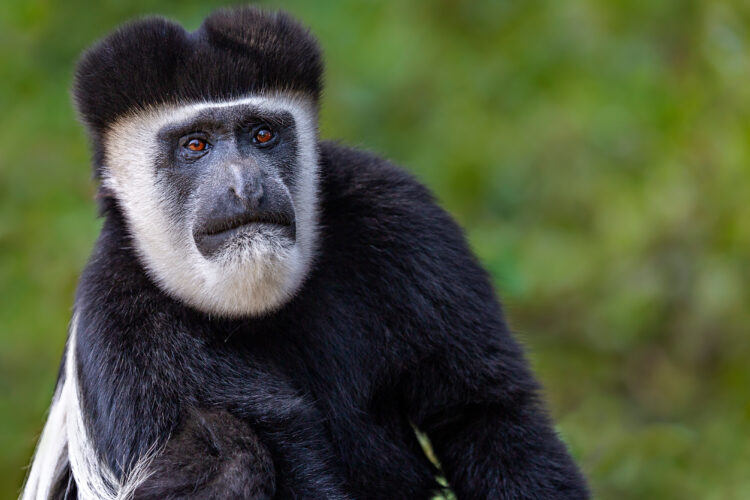
The black-and-white colobus monkey lives in Central and East Africa and spends most of its time high up in the treetops. The species is easily recognisable by its black-and-white fur and the long white hairs that grow around its face, down its back, and on its tail. The young are born completely white, but as they get older, their fur darkens and their typical black-and-white appearance develops. Colobus monkeys live in family groups of six to ten individuals. Each group consists of several related females, their young and one adult male. It is usually the oldest females that decide when the group will eat, rest, or move. Family bonds are important, and when a new young is born into the group, all the females in the group help to care for the infant. To keep other family groups at bay, the male roars at dawn and dusk. Their diet consists mainly of leaves, but also of fruit. As leaves are partly quite low in nutrients, the colobus monkey needs to eat large quantities every day. The colobus monkey's digestive system is well developed with a two-part stomach, making it a ruminant, which helps it to break down the indigestible cellulose in the leaves. Park Zoo participates in the European Endangered Species Programme (EEP) for the conservation of the Colobus monkey.
CITES B
The facts
| Scientific name | Black-and-white colobus |
| Weight | 8–14 kg |
| Food | Leaves, plants and fruit |
| Gestation period | 158 days |
| Number of cubs | 1 pc |
| Lifespan | about 30 years |
| Living environment | Forest |
| Distribution | Central and East Africa |
| Way of life | Family groups |
Taxonomy
| Class | Mammals (Mammalia) |
| Organisation | Primates (Primates) |
| Family | Old world monkeys (Cercopithecidae) |
| Type | Guereza |
