Floodplain – New Resident
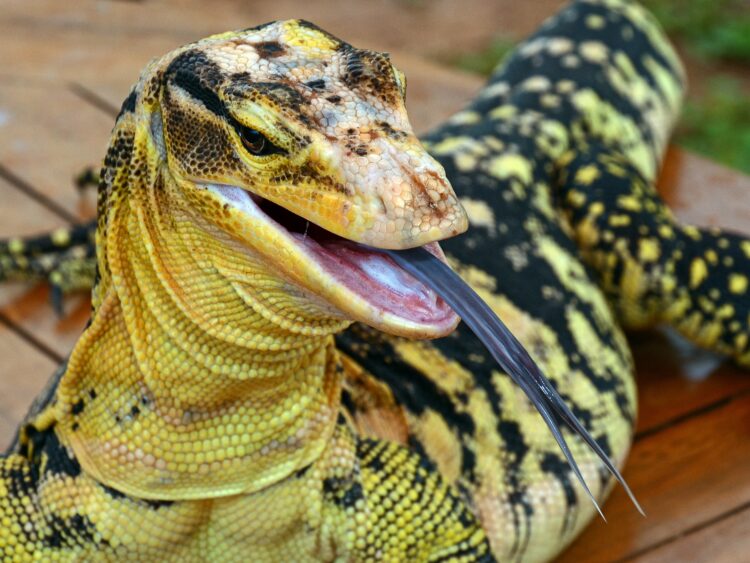
The monitor lizard, also known as Varamus cumingi in Latin, is named after the naturalist Hugh Cuming, who discovered the species in the Philippines in the early 1800s. The monitor lizard is an impressive lizard native to the tropical forests of the Philippines. With its sturdy body, long tail, and distinct yellow spots against its dark skin, it is both elegant and easily recognisable. An adult individual can grow over a metre long and weigh around 2.5kg. Despite its imposing appearance, it is usually shy and tends to avoid humans.
In the wild, the species lives near water, where it is a skilled swimmer and climber. Its diet includes everything from insects and crustaceans to smaller vertebrates and eggs. Like other monitor lizards, the species is curious and intelligent, with a well-developed sense of smell that helps it find food.
The facts
| Scientific name | Varanus cumingi |
| Size | 120-150 cm |
| Weight | 2.5-5 kg |
| Food | Rodent, fish, bird, insect |
| Gestation period | 190 days |
| Number of cubs | 6-15 eggs |
| Lifespan | 10-15 years |
| Living environment | Forest, scrubland, mangrove forest |
| Distribution | The Southern Philippines |
| Way of life | People living alone |
Taxonomy
| Class | Reptiles (Reptilia) |
| Organisation | Moulting reptiles (Squamata) |
| Family | Varanids (Varanidae) |
| Type | The Cloud Monitor (Varanus cumingi) |
