Flamingo
African animals
Birds
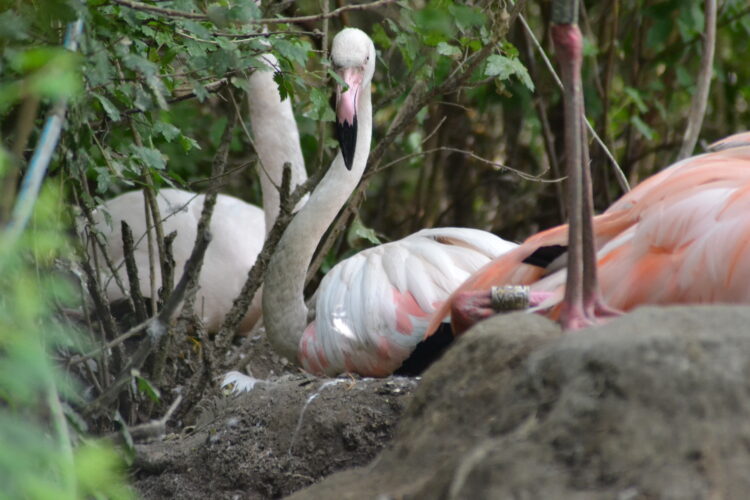
The flamingo is a long-legged, social bird that lives in colonies ranging from 20 individuals to tens of thousands. Flamingos walk around with their heads down in the water, stirring up the mud on the bottom with their feet to get their food. With its tongue, the flamingo pumps water through its specialised beak, which has comb-like plates called lamellae that act as a filter. There are six species of flamingo. At Parken Zoo you can see the greater flamingo (Phoenicopterus roseus) they are the largest and most widespread of the flamingo species. Flamingos get their colour from the crustaceans and algae they eat. The flamingo is not considered to be endangered today, but in the wild the species is being disturbed by factors such as pollution and habitat loss due to tourism. Although it is estimated that there are around 550 000-680 000 individuals of this species in the wild today, the number of breeding sites is likely to be fewer than 30, making the flamingo highly vulnerable to local environmental changes. The total population size also varies from year to year depending on drought, water levels and food availability. The greater flamingo is social and communicates with a lot of sound and movement, they can move in large groups in what can be perceived as a dance. They form pairs and build raised nests from materials such as clay, the nests are about 30 cm high and must be able to keep the eggs dry during rises and falls in the water levels where they nest. Flamingos lay eggs that are incubated by both parents for four to five weeks before they hatch. The chicks are fed by their parents with a milky secretion secreted from the parents' oesophagus. Flamingo chicks are not born pink, but have grey plumage. They start to leave the nest after 7-10 days and are ready to fly at between 65 and 90 days of age. Sexual maturity is reached between four and six years of age.
CITES A
The facts
| Scientific name | Phoenicopterus roseus |
| Size | 120-145 cm |
| Weight | 2-3.5 kg |
| Food | Crustaceans, small fish, insects, grasses and algae |
| Gestation period | The egg is incubated for 27-31 days before hatching |
| Number of cubs | 1 pc |
| Lifespan | Up to 40 years |
| Living environment | Shallow salt, brackish and fresh water |
| Distribution | Greater Flamingo: Africa, southern Europe, south-west Asia |
| Way of life | Group living |
Taxonomy
| Class | Birds (Aves) |
| Organisation | Flamingo birds (Phoenicopteriformes) |
| Family | Flamingo (Phoenicopteridae) |
| Type | Greater Flamingo (Phoenicopterus roseus) |
