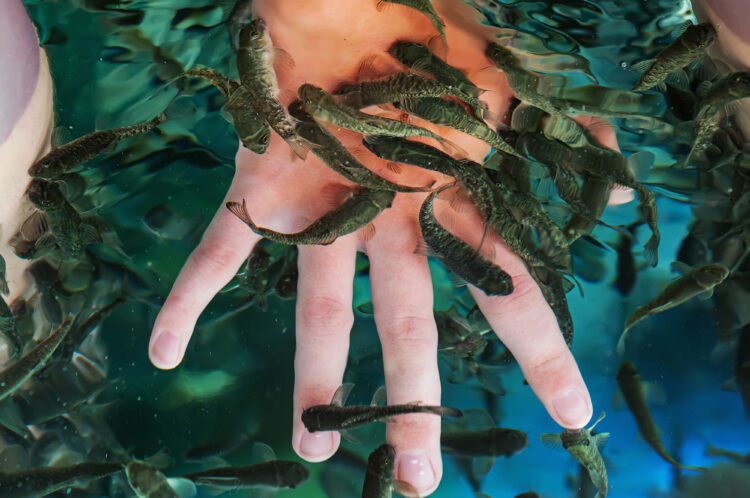
Doctor fish – New resident
The doctor fish is known by several names, such as spa fish and psoriasis fish, because they happily nibble away dead skin. They have no teeth, but instead a sucker-like mouth designed to enable them to eat things such as algae, which they scrape off rocks. The first documented treatment with doctor fish was in 1917 in the Kangal region of Turkey, where the local population discovered that they ate dead skin cells. With their gentle way of grooming the skin, they have since spread as nature's skin carers. In the wild, they live in flowing freshwater and can cling to rocks thanks to their sucker-like mouth. They play an important ecological role in the wild by cleaning up the environment through also eating organic matter and algae, which helps to keep the freshwater environment clean.
Do you dare put your hands in and test?
The facts
| Scientific name | Garra rufa |
| Size | 14 cm |
| Weight | 15 grams |
| Food | Herbivores and omnivores |
| Gestation period | Egg scatterer, the eggs hatch within 1-2 days |
| Number of cubs | 50-300 per kull |
| Lifespan | 4-8 years |
| Living environment | Freshwater |
| Distribution | Western Asia (Afghanistan, Iran, Iraq, Jordan, Lebanon, Syria, Turkey) |
| Way of life | Group living |
Taxonomy
| Class | Ray-finned fishes |
| Organisation | Carp-coloured fish |
| Family | Carp |
| Type | Garra rufa |